


Europe’s construction sector continues to recover but slower than expected
The outlook from the 101st EUROCONSTRUCT Conference for the European construction sector remains cautiously positive, but growth is forecast to be slower than previously expected.
By Markku Riihimäki, Forecon, Finland
Since the Euroconstruct forecast in November 2025, the operating environment for construction has changed in many ways. Based on the latest data released at the 101st Euroconstruct Conference (held in Helsinki on 4 and 5 June 2026), the outlook for the European construction sector remains cautiously positive, but growth is forecast to be slower than previously expected. The conflict in the Middle East and the situation in the Strait of Hormuz is having significant impact on the global economy, energy prices, inflation and interest rate trends – all factors that weigh heavily on demand in the construction sector. Consumer and business confidence in the future has fallen, and economic forecasts have been revised downwards in several countries over the spring. It is likely that this uncertainty will continue.
In the Eurcontruct countries (EC-19), gross domestic product grew by 1.5% in 2025. Between 2026 and 2028, GDP is forecast to grow by an average of 1.2% per year. Growth in 2026 will remain weaker than previously estimated at 1.1%; in 2027, it is set to be 1.3%. However, none of the EC-19 countries is forecasting negative economic growth.
Construction growth in 2026 is lower than previously forecast
Total construction output in the EC-19 countries grew by just 0.2% in 2025. Growth was slightly weaker than the November 2025 forecast, which had estimated growth at 0.3%. In 2026, construction is forecast to grow by 2.0%, whereas six months ago the expectation was 2.4%. The growth forecasts for 2027 and 2028 remain unchanged at 2.2% and 1.9% respectively. Overall, construction output in the EC-19 area has developed fairly steadily in recent years, although 2023 and 2024 were years of decline. During these two years, output fell by just over 3% in total. The growth forecast for 2026–2028 is just over 2% in total, indicating that the recovery will continue but at a moderate pace.
Civil engineering remains the strongest sector
The various sectors of construction developed very differently between 2023 and 2025: residential output reduced sharply, non-residential construction remained unchanged overall, while civil engineering grew. During the forecast period of 2026–2028, all sectors are expected to grow. In recent years, fluctuations in new construction have been significantly greater than those in renovation. Between 2023 and 2025, the output of new building construction fell, while building renovation only slightly reduced. During the period of 2026–2028, the output of new building construction is expected to grow higher than building renovation. The slow growth in renovation is primarily due to weaker consumer confidence due to uncertainty and the limited willingness of households to invest in home improvements.
In civil engineering, both new construction and renovation grew strongly between 2023 and 2025. During the period of 2026–2028, both new construction and renovation are expected to grow on the back of transport investments, energy infrastructure, security and contingency planning needs, adaptation to climate change, and projects supported by EU programmes.
One of the key findings in the new forecast is that the structure of construction growth has changed. New construction and civil engineering are more clearly the drivers of growth than previously, while renovation remains stable but in a phase of slower growth. The counter-cyclical role of building renovation has weakened compared to the years of the energy crisis and the energy efficiency boom, when subsidy schemes and regulation boosted the market more strongly. Economic and consumer uncertainty is now weighing on renovation, while investment is benefiting new construction.
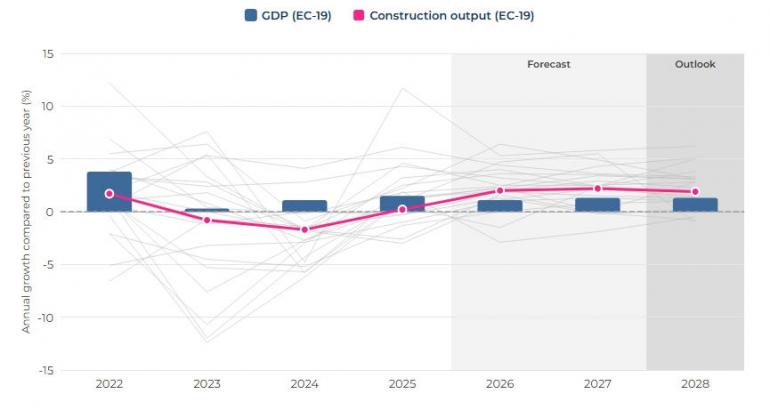
Source/fonte: EUROCONSTRUCT, June 2026.
Developments remain highly varied by country
Construction trends across different parts of Europe continue to diverge significantly. In the Nordic countries and Austria, total construction output fell sharply in 2023 and 2024 and will not return to 2022 levels during the period. In these countries, the primary underlying factor is a sharp collapse in new residential construction.
The strongest growth in construction between 2025 and 2028 is forecast for Ireland, Poland, the UK and Portugal. Growth is weakest in Slovakia, Italy and Belgium. Ireland continues to stand out as the fastest-growing market, thanks to strong public investment and steady demand. Poland is also benefiting from strong medium-term growth, although forecasts have been revised slightly downward. Spain and Portugal, in turn, are benefiting from broad-based growth in both building construction and civil engineering. Germany, France, Austria and Italy continue to suffer from weak housing demand, high costs and limited financing.
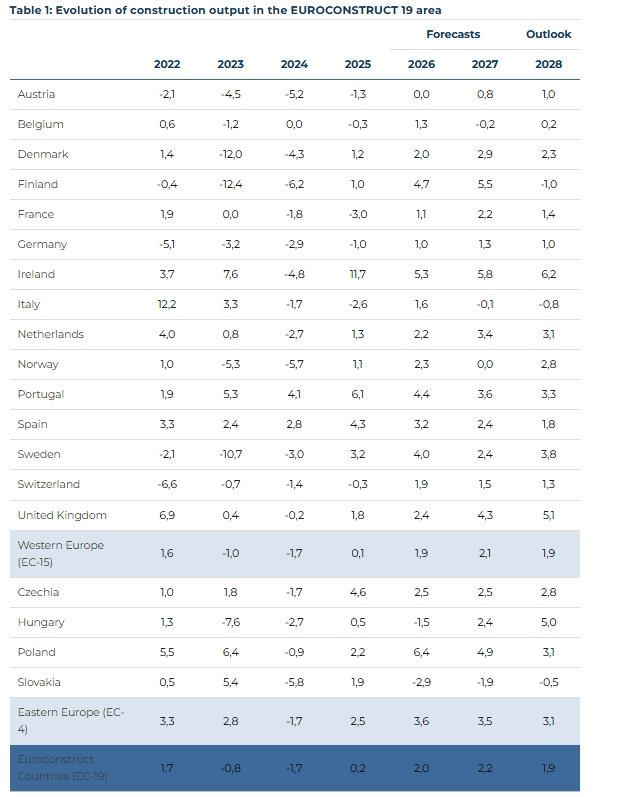
Source/fonte: EUROCONSTRUCT, June 2026.

Did you find this article useful?
Join the CWW community to receive the most important news from the global ceramic industry every two weeks





Related articles



Recent articles

Indian Ceramics Asia rebrands as Ceramics India

Minerali Industriali Group at Tecna 2026

Dellas expands its range of polishing tools


Leadership transition at Mohawk Industries

Main topics

Read more