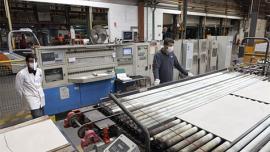
The Italian ceramic industry, considered a sector of “strategic importance as it is strongly export-oriented” has been given the go-ahead to resume production activities as of 27 April.
Confindustria Ceramica and the trade unions have already signed a protocol to guarantee the resumption of ceramic production in complete safety. Industrialists call for factories to be reopened as soon as possible.
The Castellón ceramic district is reopening after the two weeks of non-essential production activity shutdown imposed by the Sánchez government on 29 March. Construction sites also get the go-ahead
The order issued on the evening of Friday 3 April by the Italian Ministry of Health and the Emilia Romagna Regional Government authorises companies to sell products in stock in Italy and abroad.
The appeal made by the Chairman of the Italian Federation of Capital Goods Manufacturers, which includes ACIMAC (ceramic machinery manufacturers’ association), to the Italian institutions and the employers’ federation Confindustria to allow companies to reopen from 13 April.
Giovanni Savorani, Chairman of Confindustria Ceramica, sounds the alarm: “We are extremely concerned because the decisions taken by the Italian government to prevent the spread of the virus are harming the competitiveness of the sector.”
In 2019, U.S. ceramic tile consumption declined for the first time in a decade to 273.2 million sq.m. (-5,4% on 2018). This affected both the domestic production (83 million sq,m, -4.8%) and imports (193 million sq.m, -5.5%), with China dropping by 36.4%.
The Spanish ceramic tile industry recorded a 4% growth in turnover in 2019 to 3,740 million euros, thanks to the strong performances both on the domestic market (+8) and on the exports markets (+3%). Production fell to 503 million sq.m (-5%)
Tile production in Bangladesh has grown by 150% in the space of just 5 years, reaching 119 million sq.m in 2018. DBL Ceramics stands among the local largest ceramic tile producers.
With an installed capacity already in excess of 40 million pieces/year, India is the world’s second largest sanitaryware producer. 75% of production comes from Gujarat.
In 2019, production and sales remained stagnant at 409 million sq.m. Non-European markets saw the biggest falls, while the domestic market made a slight recovery.
With a production of about 114 million sq.m, Nigeria is now the second largest tile producer in Africa, with 8 manufacturing companies, of which 6 financed entirely by Chinese capital
Production and exports will continue to grow. The new challenge comes from the introduction of 42.9% antidumping duties on Indian tiles in the Gulf States.