
Magnetic installation technology revolutionizing surface applications
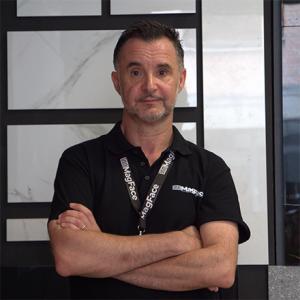
The traditional installation of floors and wall coverings, involving mortars, adhesives and long curing times, is often complex, costly and environmentally impactful. From this observation came MagFace, the magnetic installation system conceived by Andrea Bassi, CEO of Bassi Group International, together with his team. The manager explains how and why this technology has revolutionized the concept of installation, making it fast, clean and fully sustainable.
What inspired you to develop MagFace?
The idea was born in 2010 during the renovation of our company headquarters: twelve months of disruption, dust, debris and structural damage. That experience created an urgent need to eliminate the problems associated with traditional installation methods and replace them with a ready-to-use system compatible with any type of surface covering. MagFace is a compact solution only 1 mm thick, fire-resistant, waterproof, decoupled and fully recyclable. In 2015 we filed the patent first in Italy and then globally, successfully passing all certification tests, including those conducted in the USA and China. Today, MagFace is the only patented magnetic installation system in the world capable of supporting surface coverings weighing up to 110 kg/m².
What is the most disruptive innovation of this technology compared with traditional methods?
MagFace combines three key elements that make it unique: secure anchoring, certified sustainability and minimal structural thickness. Unlike traditional installation with mortars and adhesives, it uses a dry mechanical-magnetic fixing system that is completely reversible and free of VOCs, setting a new standard for circular economy practices in the industry. Compared with floating or click-lock systems, MagFace offers greater stability, resistance to heavy traffic and enhanced structural safety.
The system adapts to both large and small formats. How does it maintain safety and stability across such different surfaces?
MagFace’s ability to ensure safety and stability—from mosaics to large slabs (160×320 cm with thicknesses up to 20 mm)—derives directly from its innovative mechanical-magnetic anchoring system. Rather than relying on adhesive strength per unit area, the system exploits the uniform and permanent magnetic traction generated by an ultra-thin film (1 mm) applied to the back of the covering material. This approach transforms the entire contact surface into a constant fixing area, creating a total perimeter force and effective structural decoupling. In large formats, stability is further guaranteed by the high certified resistance to shear and vertical detachment, ensuring a solid and durable fixing even under heavy loads.
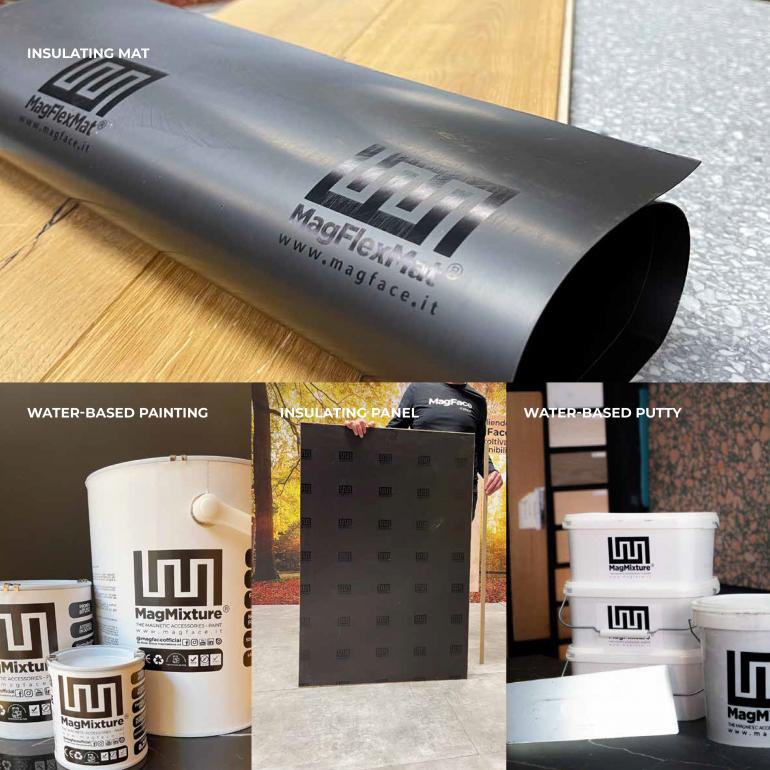
Considering the shortage of specialized labor, how can MagFace make tile installation easier for less experienced operators?
MagFace addresses this issue through maximum standardization and mechanical simplification of the installation process, drastically reducing dependence on the installer’s experience and skill. In traditional systems, quality depends on the installer’s ability to manage chemical factors such as mixing, curing times and adhesive distribution. With MagFace, installation is reduced to five simple dry steps. The system provides immediate and guided anchoring: the installer simply places the tile onto the magnetic base, eliminating adhesive curing times and reducing almost to zero the defects typical of traditional installation. This has a direct impact on the training time required for new operators.
MagFace complies with standards such as ASTM C627-10 and directives on magnetic fields. How important are these certifications?
Certifications are not just quality seals; they are the key to accessing international markets, especially for contract projects and large-scale developments. ASTM certification guarantees resistance to heavy traffic, while directives on electromagnetic fields (2013/335/EU and 159/2016) ensure safety for both users and installers, with emissions far lower than those produced by a common smartphone.
What role will this technology play in sustainable construction?
The technology eliminates the need for demolition, avoiding landfill waste and drastically reducing carbon footprint. Tiles become reusable and infinitely inspectable assets, enabling rapid restyling projects without generating construction waste. The complete elimination of adhesives, cement and resins (VOC emissions) significantly improves indoor air quality (IAQ), which is essential for certifications such as LEED and BREEAM.
Does MagFace also contribute to improving thermal and acoustic comfort in indoor environments?
Yes, the system was also developed with this objective. Thanks to the patented magnetic rubber covers, the surface elements connect through magnetic adhesion, creating a stable and continuous installation plane. This reduces the formation of micro-voids between elements, typical of some floating or interlocking systems, promoting more uniform heat transmission and helping reduce footstep noise. Indicative test results show a reduction in impact noise of approximately –5 / –8 dB and a more homogeneous heat distribution, with a perceived increase in surface temperature of about +1 / +2 °C, thereby improving overall spatial comfort.
The project also opens opportunities in temporary applications…
Exactly. In temporary projects such as trade fairs, pop-up stores and rental spaces, the cost and disposal of traditional installation methods represented a major obstacle. Thanks to its total reversibility, MagFace creates the ideal conditions for a “pay-to-use” or rental model. Surface coverings therefore shift from a fixed, non-recoverable expense to a circular and flexible investment: clients can rent them for the duration of a project and then remove them without damaging the underlying floor, recovering the material for subsequent reuse.
What impact does MagFace have on installers and end users?
MagFace positively transforms both roles. For installers, installation is up to five times faster, with immediate walkability and no adhesive curing time. It guarantees perfect alignment and structural flatness, reducing stress and post-installation complaints. End users benefit from immediate usability and the absence of dust and chemical odors.
Which sectors are likely to benefit most from the system in the coming years?
Although suitable for residential use, the most promising sectors are contract, retail, hospitality and modular construction. MagFace enables fast installations without operational interruptions and offers heavy duty resistance, making it ideal for hotels, restaurants and high-traffic spaces. Its level of standardization also makes it particularly suitable for prefabrication and green building projects.
In which fields do you plan to extend MagFace applications?
Over the next few years, the objective will be to expand into high-performance materials such as sintered stone, marble, granite and composites, including ultra-thin slabs for walls (up to 100×300 cm, 2–3 mm thick) and floors (5–6 mm). Future developments will also include complex vertical applications such as ventilated façades, modular walls, furniture and nautical environments, as well as active surfaces integrated with IoT technologies or wireless charging systems. In short, MagFace will not simply be a more efficient installation method, but the catalyst for a new generation of intelligent, modular and fully sustainable surface
It is available exclusively under a non-exclusive territorial license.
www.magface.it - [email protected]

Did you find this article useful?
Join the CWW community to receive the most important news from the global ceramic industry every two weeks





Related articles


Recent articles


Sirsi Valves accelerates its growth


Bruno Bettelli elected President of ACIMAC
Main topics

Read more