
ANFFECC: sector revenues up in 2025, but rising costs and the ETS take their toll
According to the association’s figures, the Spanish ceramic frit, glaze and colour sector grew by 1.5% in 2025. However, concerns are mounting over higher energy costs and planned reductions in ETS allowances, which are threatening the industry’s competitiveness.
The Spanish ceramic frit, glaze and colour sector closed 2025 with growth, confirming its strong international focus. According to figures published by the trade association ANFFECC, member companies reported total revenues of €1,363.5 million in 2025, an increase of 1.5% compared with 2024. Exports remain the main driver of the sector, reaching €891.4 million (+2.7%) and accounting for 65.4% of total sales. In contrast, the domestic market continues to show signs of weakness with sales of €472.1 million, down slightly on 2024 (-0.5%).
The sector remained largely stable in terms of output, with production reaching 1.5 million tonnes in 2025, a year-on-year increase of 0.4%.
Despite these positive figures, ANFFECC points to an increasingly complex operating landscape.
“The pressure of energy and strategic raw material costs is weighing heavily on our companies’ daily operations,” noted the association’s chairman Fernando Fabra. “In some cases, prices have risen by between 30% and 177% in just a few months, directly impacting profit margins.”
The impact of the ETS system
A further cause for concern is the European Emissions Trading System (ETS). According to association estimates, the planned reduction in free allowances will cost Spanish frit and glaze producers more than €55 million between 2026 and 2030, a scenario that heightens the risk of industrial offshoring.
“When Europe imposes costs and obligations that exceed those of its global competitors, investment decisions are postponed or redirected to other countries,” commented Fabra. “Environmental protection and competitiveness are not mutually exclusive, but the transition must be technically feasible, economically sustainable and aligned with global competition. Businesses must remain profitable if they are to continue to invest in innovation and sustainability.”
Commitment to decarbonisation
At the same time, the sector remains committed to investing in emission-reduction technologies. 2025 saw the completion of the H2frit project, which demonstrated the technical feasibility of using hydrogen in ceramic frit fusion processes. However, economic sustainability will depend on a number of external factors, including security of supply, the regulatory framework, infrastructure development and competitive pricing.
Meanwhile, ANFFECC is drawing up a decarbonisation roadmap for the sector. This includes various technological options such as process electrification, the use of renewable gases, improved energy efficiency and CO₂ capture and utilisation technologies with the aim of identifying new solutions for reducing emissions while maintaining profitability and international competitiveness.
The impact of the war in the Middle East
These challenges are compounded by concern over the war in the Middle East, which has already impacted gas and logistics costs as well as supply chains.
The Middle East and surrounding regions represents an important market for Spanish producers, with exports of ceramic frits, glazes, colours and inks totalling approximately €250 million in 2025.
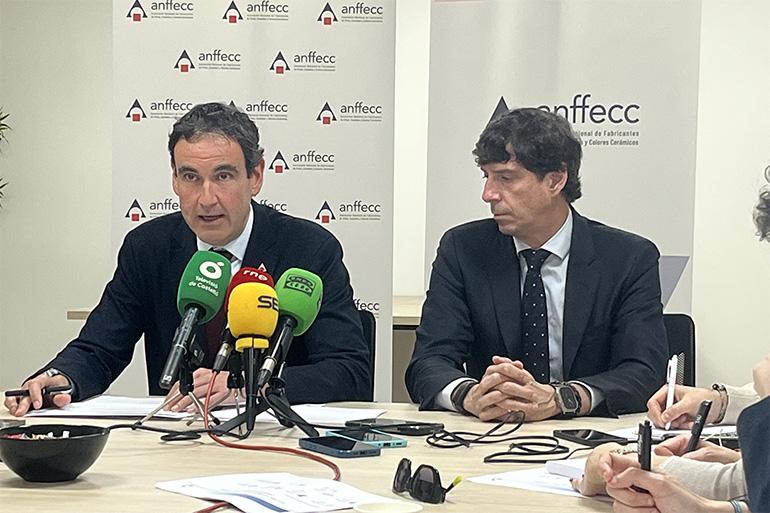
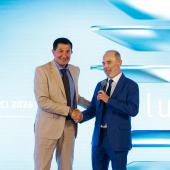
Fernando Fabra, Chairman of Anffecc, and Manuel Breva, the association’s secretary

Did you find this article useful?
Join the CWW community to receive the most important news from the global ceramic industry every two weeks





Related articles

Recent articles
Sirsi Valves accelerates its growth

Bruno Bettelli elected President of ACIMAC

Main topics
Read more