

Italian ceramic machinery manufacturers close 2025 with €1.73 billion in revenue
Exports account for 69.4% of total turnover. The industry is affected by the slowdown in global investment but maintains employment levels and technological leadership.
The Italian ceramic machinery and equipment industry closed 2025 with total revenue of €1.73 billion, marking a 5% decline compared to the previous year. Nevertheless, the sector continues to rest on solid industrial foundations, with a stable workforce of 7,153 employees, unchanged from 2024, and a strong international outlook, with exports accounting for 69.4% of total turnover.
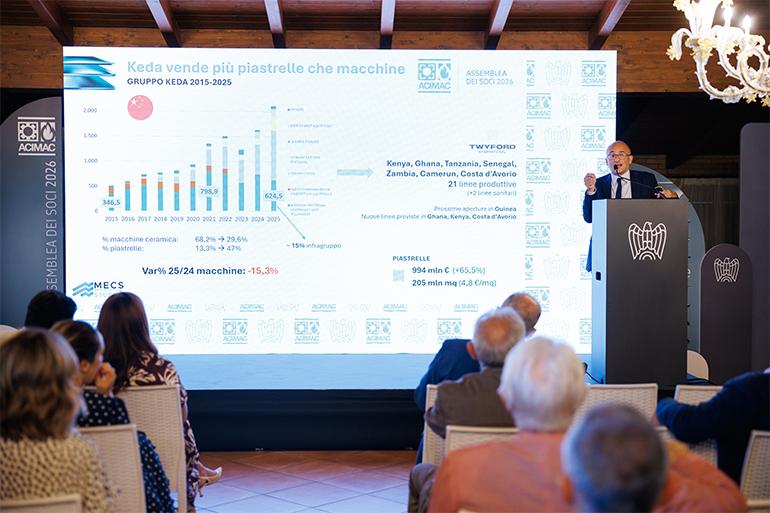
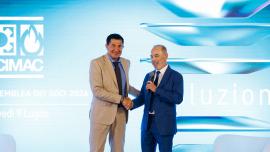
The figures emerge from the statistical survey conducted by ACIMAC – MECS Research Centre and presented during the national Association's Annual General Meeting on July 9th, 2026.
The slowdown recorded in 2025 also confirms the challenging phase currently affecting the entire European ceramic supply chain. Alongside declining investment, the industry is facing growing international competitive pressure, impacting not only machinery manufacturers but the entire industrial ecosystem, from component suppliers to ceramic tile manufacturers.
International markets
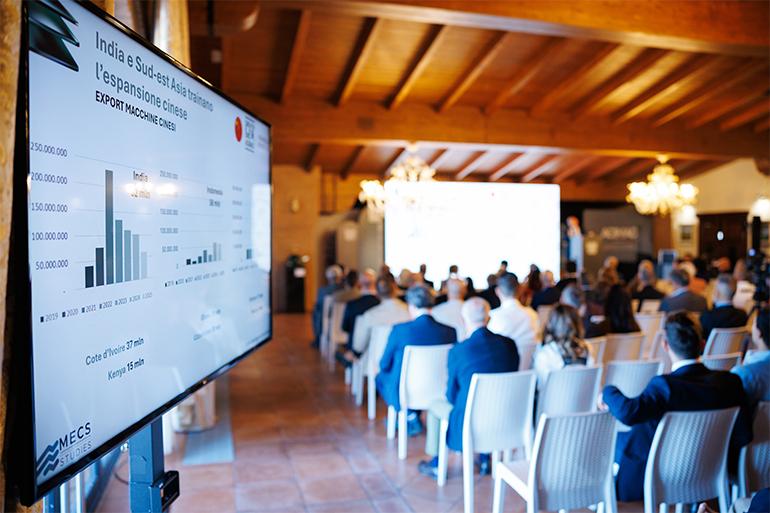
Exports continue to represent the primary outlet for Italian ceramic technologies, despite an international environment marked by slowing investment, geopolitical instability and widespread economic uncertainty. In 2025, exports declined by 6.9% compared to the previous year, reaching a total value of €1.2 billion.
Performance across destination markets was mixed. North America (+16.4%), the European Union (+11.5%) and the Middle East (+9.1%) recorded growth, confirming the ability of Italian companies to strengthen their presence in high-potential markets. More challenging conditions were experienced in other regions, with exports declining to Africa (-37.5%), China (-32.2%), Eastern Europe (-25.4%), other Asian countries (-23.6%) and South America (-10.6%).
Markets and client sectors
The industry reflected the differing trends affecting its client sectors. Overall, the ceramics segment recorded a 5% decline, although performance varied considerably across the different application sectors.
The strongest growth was achieved in technical ceramics, which increased by 181.1%, confirming the growing demand for high-technology applications. Positive results were also recorded in the tableware sector (+21.2%) and the heavy clay industry (+11.9%). By contrast, declines were recorded in ceramic tiles (-5.0%) - although still accounting for 83.6% of total turnover -, sanitaryware (-19.6%) and refractories (-26.9%).
Technologies
Analysis by machinery category reveals uneven demand across the various stages of the production process. Growth was recorded for forming technologies (+8.8%) and raw material preparation equipment (+5.3%), while declines affected finishing machinery (-1.0%), moulds (-3.8%), digital decoration (-4.6%), glazing and decoration equipment (-7.3%) and storage systems (-21.1%). The most significant slowdown concerned firing technologies, which declined by 33.8% compared to 2024.
Industry structure
In 2025, the industry comprised 133 companies, two fewer than the previous year, while maintaining a stable workforce of 7,153 employees. This confirms the sector's resilience despite a less favourable economic environment than in previous years.
Bruno Bettelli: "Innovation and a global presence remain our key strengths"

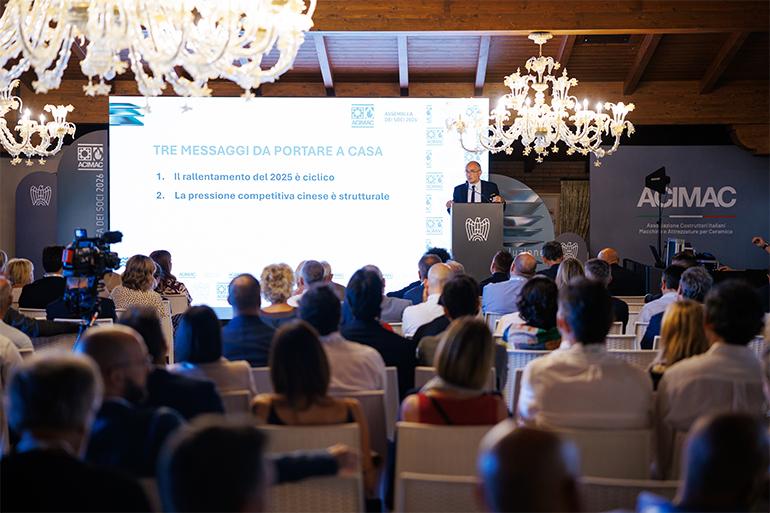
"2025 confirms that the ceramic technology industry is going through a challenging phase that extends beyond the normal cyclical dynamics of the market," said Bruno Bettelli, the newly elected President of Acimac. "The slowdown in investment and the growing intensity of international competition are placing the entire European ceramic supply chain under pressure, from machinery manufacturers to component suppliers and ceramic tile producers.
In particular, we are witnessing the emergence of industrial and commercial models operating on a global scale according to very different principles from those that have traditionally characterised European manufacturing. Competition is no longer based solely on labour costs, but increasingly involves production scale, financial strength, support for internationalisation and speed of market access.
In this environment, our priority is to continue investing in technology, skills, sustainability and customer service, while safeguarding the value of Made in Italy and the innovation capabilities that have made the Italian ceramic machinery industry a global benchmark. The challenge over the coming years will be to strengthen the competitiveness of our companies and support them through a period of profound transformation in global industrial dynamics."

Did you find this article useful?
Join the CWW community to receive the most important news from the global ceramic industry every two weeks





Related articles


Recent articles


Bruno Bettelli elected President of ACIMAC


HOB Certec: next stop TECNA 2026

Main topics
Read more